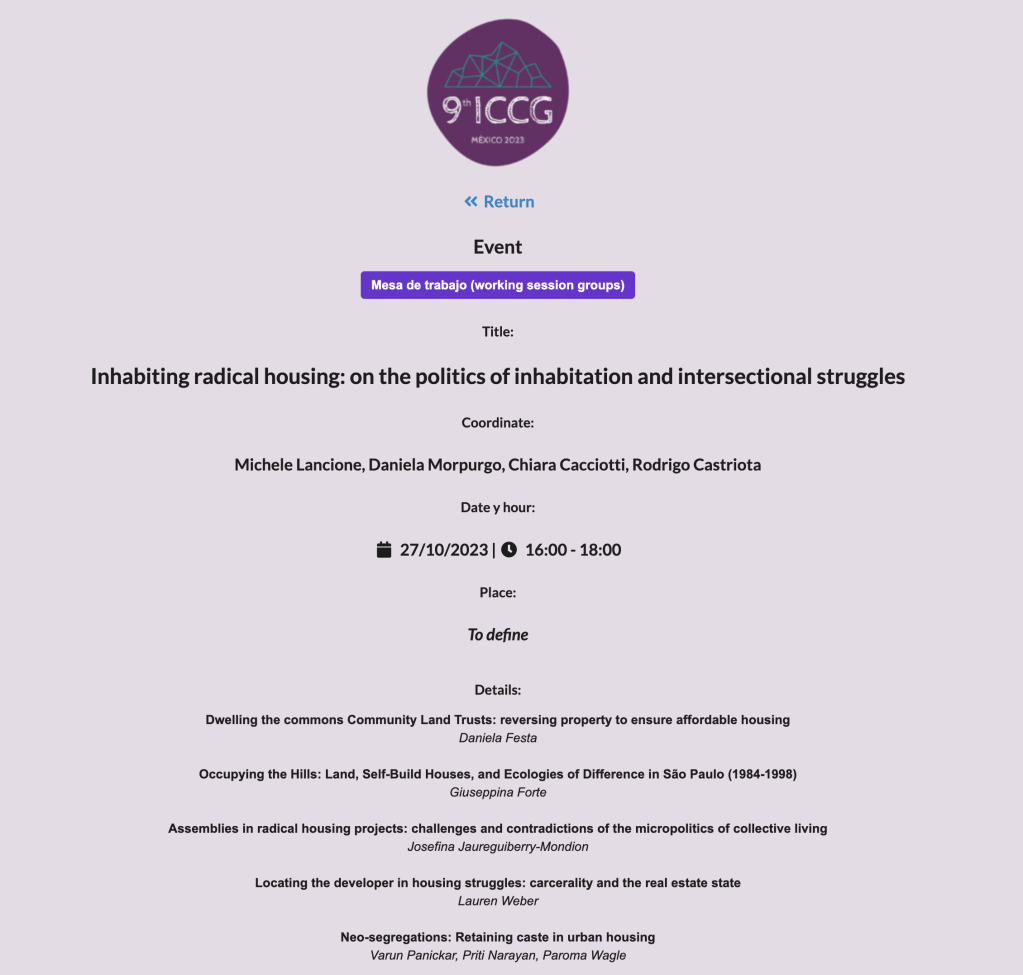
Occupying the Hills: Land, Self-Build Houses, and Ecologies of Difference in São Paulo (1984-1998
Giuseppina Forte
In presentation, I analyze housing struggles as sites in which new political identities emerge at the intersection of gender, race, class, and the environment. My entry points to these dynamics are the large-scale occupations of rural lands to access housing in São Paulo’s northern periphery during the Brazilian democratization period. In the 1980s and 1990s, the embodied identities of working-class women (many Black and Brown) were crucial to securing access to land and self-build houses.
My analysis combines land occupations at the feet of the Serra da Cantareira Forest (Morro do Quiabo and Filhos da Terra), self-build practices (Jardim Apuanã), and infrastructure disputes (Jardim Felicidade). In São Paulo’s northern periphery, housing struggles cannot be separated from mobilizations for land and infrastructure. On the one hand, land occupations and self-build practices pressured the city government to provide infrastructure for low-income people. On the other hand, self-built houses and infrastructure provisioning led the municipality to recognize land rights.
To develop my argument, I draw on recent scholarly approaches that consider the field of politics as an ecology. According to these approaches, political agency adapts constantly to changing conditions. As a result, contentious politics configure fields of interdependence and feedback loops that create opportunities, challenges, and conflicts. By considering the distributed and relational forms of contentious politics, my presentaation’s contribution to understanding housing struggles is twofold:
First, it sheds light on the formation of specific embodied identities (e.g., the “women-warriors,” the militant women, the women self-builders) through land, housing, and infrastructure struggles. Following feminist attention to the body as a site of contestation and exercise of power, my focus is on the emergence of political agency at the intersection of bodies and ecologies. Women were differently positioned subjects involved in the contentious politics of the 1980s and 1990s, with distinct bodily experiences shaping their political identity. In São Paulo, they played with bourgeois imagination around poverty to threaten public officers and used their assigned societal gender roles in transformative ways to disrupt entrenched gender roles. Embodied practices and strategies on the fly were tools to subvert and resignify places associated with male institutional power.
Second, I demonstrate how nonhuman agents, such as hills, creeks, the forest, and soil, are crucial for constructing different political identities and shaping housing movement outcomes. The presence of the Serra had a significant impact on social movements’ camouflage techniques, guerrilla tactics, visibility, and invisibility that permeated their land encroachments and housing struggles. From hillsides to institutional halls, women’s actions involved fires, rocks, bricks, water, and filth. I focus on how they enacted forms of oppression and resistance through specific material politics. By articulating the multi-scalar geographies of contentious politics—circulation, networks, nature, and bodies—I aim to facilitate an understanding of the materiality of occupied spaces, self-build housing, and everyday politics.
Drawing on archival, ethnographic, and visual methods, ultimately, this paper provides a rich analysis of the political activation of São Paulo’s hills for housing access during the Brazilian democratization period. It emphasizes how intersectional identities and material and ecological formations shape and are shaped by specific housing struggles.
 GIUSEPPINA FORTE